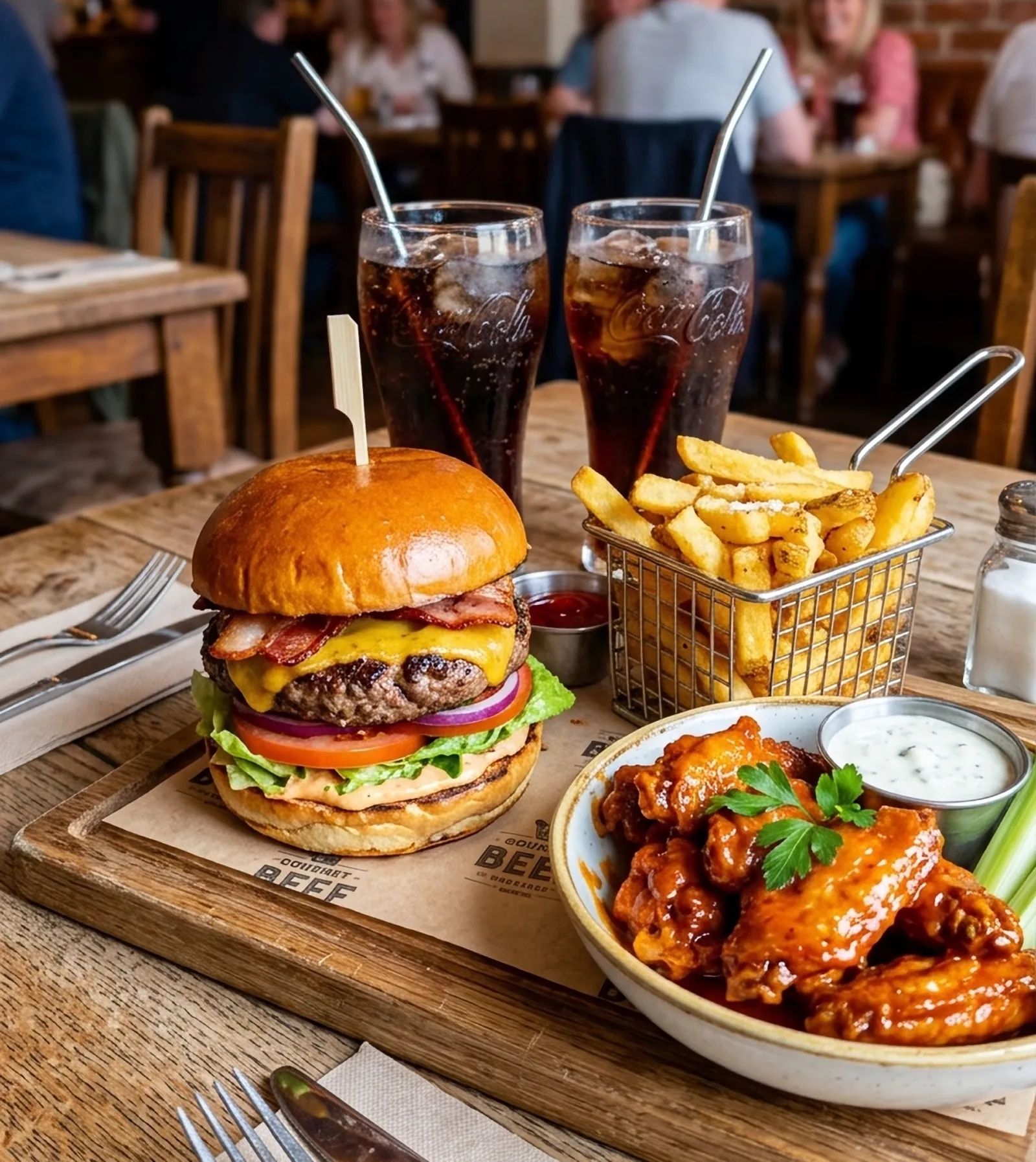

A website that finally reflects what is happening in the room
A custom platform for an Irish-inspired Digbeth bar: a page-builder CMS, database-backed menus and events, four booking flows and SEO built as infrastructure.
Redcorc Bar is an Irish-inspired bar, kitchen and live music venue on Digbeth High Street in Birmingham, trading on gigs, pre and post-show crowds, Sunday roasts, private hire and seasonal parties.
Challenge
A template site that could not keep up with the venue
Menus lived in a PDF, events lived on social media, and every booking, enquiry and loyalty sign-up arrived through a different channel. Prices moved and events came and went, but the website stayed still because nobody inside the business could change it.
- A closed template platform with no editable content model, so every copy, price or image change needed a developer.
- Table bookings, party enquiries and loyalty sign-ups handled by phone, direct message and paper, with no shared record.
- Menus published as a PDF download: poor on mobile, invisible to search and permanently out of date.
- Events promoted only on social feeds, so listings vanished down the timeline and the site never showed what was on.
- Thin metadata, no canonical strategy and no business schema, so the venue competed poorly for Digbeth and Birmingham venue hire searches.
- Enquiry data spread across inboxes and personal devices, with no access control and a real data-protection risk.
Objectives
Project Objectives
A custom website with an editorial design system
A React front end with semantic tokens for every colour, radius and shadow, and layout primitives defined once and reused, so pages built months apart still line up.
A page builder CMS the venue actually uses
Pages as ordered lists of typed sections, edited in a three-panel interface with drag-and-drop ordering, rich text and a live preview of unsaved work.
Booking, enquiry and loyalty capture
A 90-day rolling table booking window plus venue hire, Christmas party and loyalty flows, each validated with Zod and written to its own table.
Transactional email and calendar invites
Serverless functions send branded confirmations and venue notifications from a shared template registry, with .ics invites for party bookings and suppression handling.
Menu, events and media management
Database-backed menu categories, items, prices, dietary tags and availability toggles, an events panel with live preview, and one central media library.
Roles, access and data protection
Roles stored in a dedicated table and checked server-side, with row-level security on every table holding customer data and anonymous reads limited to published rows.
SEO infrastructure
Canonicals and sitemap generated from one shared module, internal routes marked noindex, business schema from a single record and a Digbeth venue hire landing page.
Solution
A purpose-built platform shaped around how the venue runs a week
The public site was rebuilt from scratch as a React application with its own design system: a charcoal-and-ember palette, Bebas Neue display type, Barlow body type and one shared spacing and container scale used by every page. Every colour, radius and shadow is a semantic token, so the site can be re-themed centrally rather than page by page.
Behind it sits a CMS in which pages are stored as an ordered list of typed sections, edited through a three-panel interface with drag-and-drop ordering, rich text editing and a live preview iframe. Section types map to real page furniture, so staff choose a block rather than face a blank canvas, and any page without CMS content falls back to its hand-built layout so the site can never render empty.
Menus, events, media, bookings, enquiries and loyalty sign-ups each have their own data model and admin screen. Table bookings run on a 90-day rolling window with date, party size and time-slot validation, alongside separate flows for venue hire, Christmas parties and loyalty sign-ups. Every submission triggers a branded customer confirmation and a venue notification, with generated calendar invites for party bookings and unsubscribe handling built into the mail pipeline.
Access is scoped from day one: roles live in a dedicated table checked through a security-definer function, and row-level security sits on every table holding customer data. SEO was built as infrastructure rather than a task, with canonicals and the sitemap generated from a single source of truth and structured data derived from one centralised business record.
Results
The Impact
Tech
Technology Stack
FAQ
Frequently asked questions
Good to knowCan venue staff really update the site themselves?+
Yes. Pages are built from typed sections that mirror the page furniture the team already understands, and the editor shows a live preview of unsaved work before anything is published.
What happened to the PDF menu?+
It was replaced with a database-backed menu of categories, items, prices and dietary tags, with availability toggles so an item can be marked off in seconds and a responsive card grid that search engines can read.
How are bookings and enquiries handled?+
Four separate flows cover table bookings, venue hire, Christmas parties and loyalty sign-ups. Each writes to its own table, appears in one admin area and triggers an automatic customer confirmation and venue notification.
How is customer data protected?+
Roles are stored in a dedicated table and checked through a security-definer function, and row-level security policies sit on every table holding customer data so only authenticated admins can read it.
More case studies
Radcliffe Knights: a volunteer-run club moved off spreadsheets and WhatsApp
A 16-page public site, an 11-step member pipeline, fixture syncing, payments tracking and safeguarding tooling, all run by volunteers.

Where the Wye Wanders: a commission-free booking marketplace for the Wye Valley
86 live listings, 31 property owners and two-way calendar syncing, built from a standing start in six months.

A browser studio that speaks hologram hardware
Hologram Studio turns PNGs, GIFs, video, 3D models and typed text into device-ready hologram content, rendered client-side and exported in the exact formats a Pepper's Ghost pyramid or a 576-LED fan expects.
Ready to Achieve Similar Results?
Let's talk about how we can drive comparable growth for your business.