A browser studio that speaks hologram hardware
Hologram Studio turns PNGs, GIFs, video, 3D models and typed text into device-ready hologram content, rendered client-side and exported in the exact formats a Pepper's Ghost pyramid or a 576-LED fan expects.
Hologram Studio is a browser-based production tool for holographic displays, built by FK Digital Alliance. It converts ordinary source material into 3D hologram content and renders it out in the layouts real hologram hardware expects.
Challenge
Plenty of 3D tools, none that speak to hologram hardware
Getting a single clip onto a holographic fan meant a modelling package, a video editor, a keying pass, a manual crop to square, a hand-built centre mask and a folder of numbered PNGs renamed by hand. The chain was long, fragile, and every mistake only surfaced once the content was already spinning on the hardware.
- Fans and pyramid rigs demand square frames, a masked centre hub and a fixed resolution and frame rate.
- Background removal needed a separate keying pass in another application, with no way to judge the key against the hologram look.
- Turning flat artwork or text into hologram-ready 3D required a modelling package.
- GIFs, MP4s and rigged models each needed a different toolchain, with nowhere to assemble them together.
- Fan output is a numbered PNG sequence plus a video, produced by hand with no progress, cancel or repeatability.
- Project files referenced assets elsewhere on disk, so reopening meant re-importing media and rebuilding geometry.
- Client work sat in unprotected local files with no access control on the studio itself.
Objectives
Project Objectives
A media-to-hologram conversion pipeline
Transparent PNGs voxelised and extruded with configurable detail, thickness and alpha cut-off; GIF and WebP decoded frame by frame with correct disposal; MP4, MOV and WebM sampled with controls for FPS, frame budget and scaling quality.
Three device outputs from one renderer
Stage, Pyramid and Fan/LED share one scene graph, shader and compositing path. Fan applies the square crop, centre-hub mask, grading and device profile; Pyramid mirrors the scene into four quadrants.
A custom hologram shader
Fresnel rim glow, animated scanlines, flicker, a vertical sweep beam and bloom in a single ShaderMaterial, plus a full-colour mode rendering native RGB with luminance-derived alpha and auto-calibration.
A timeline that behaves like a video editor
Media, 3D animation, text and audio tracks with drag, trim, split, duplicate, snapping, ripple editing, frame-accurate scrubbing, per-clip trim ranges, crossfades and ping-pong looping.
Text as a first-class hologram source
Extruded 3D type with font, weight, spacing and alignment, up to six stacked layers with their own timing, motion preset and easing, manipulable with the same gizmo as any other object.
Audio, mixing and monitoring
Zoomable waveforms, per-clip volume, fades and looping, a shared master bus into a brickwall limiter, and metering with peak-hold, dBFS readouts and clipping warnings feeding playback and export identically.
Projects, recovery and access
Self-contained bundles with embedded assets, optional PBKDF2-SHA256 into AES-GCM-256 encryption, debounced autosave with crash recovery, and authenticated access with row-level security and noindex on every route.
Solution
One application, one renderer, three device outputs
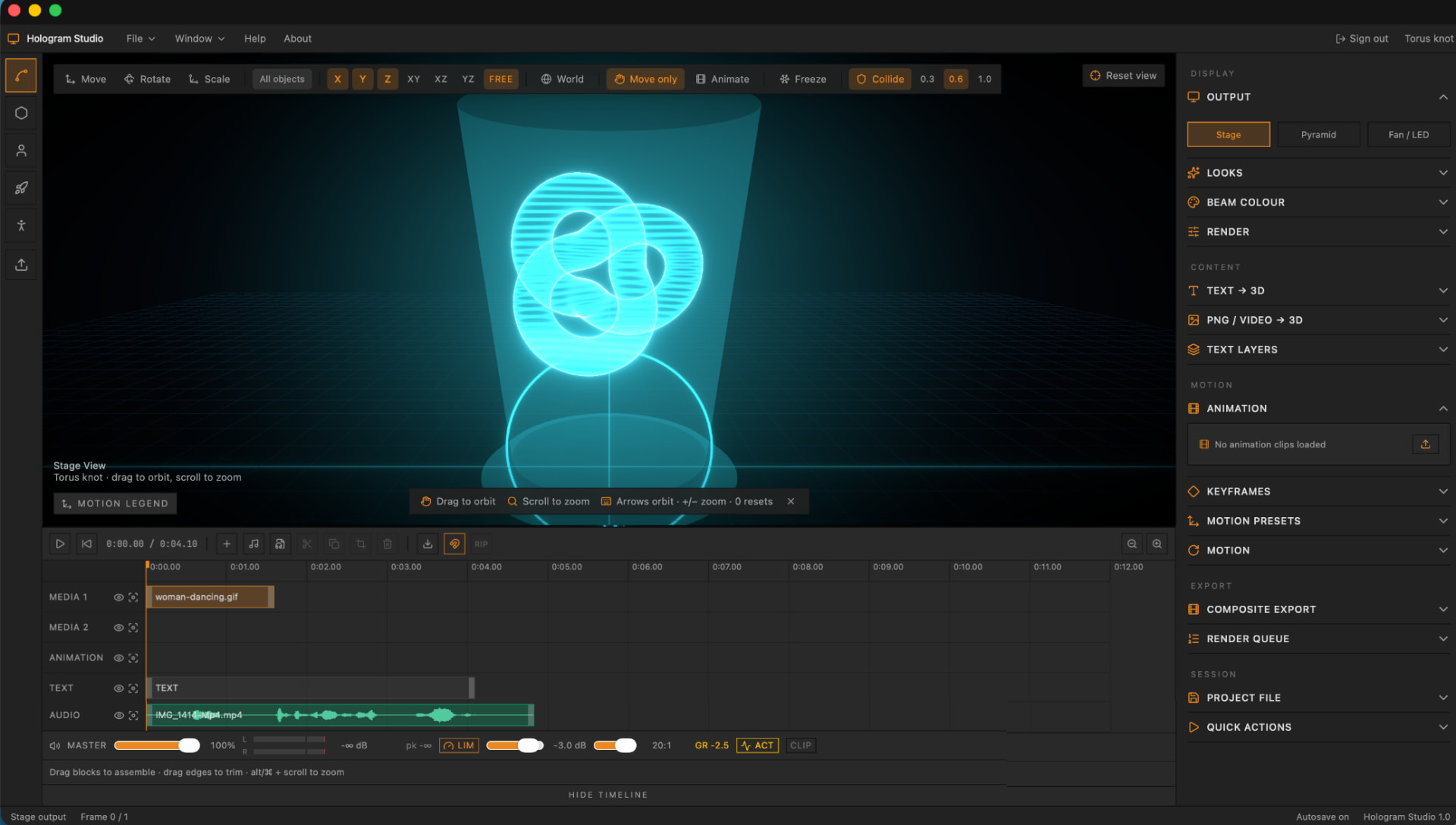
Hologram Studio is a single-screen application shaped like a professional 3D tool: viewport, tool rail, properties accordions, outliner and a multi-track timeline. Inside it a source becomes a hologram in one step. Images and video frames are keyed on luminance and extruded into geometry, models keep their own animation clips and have their textures baked down to vertex colours, and text is generated into extruded 3D layers.
Everything renders through one custom GLSL hologram shader with fresnel rim glow, scanlines, flicker, a sweep beam, bloom and an optional full-colour RGB path. Stage, Pyramid and Fan/LED are three views onto that same scene graph, shader and compositing pipeline, so the preview is a proof of the export rather than an approximation. Fan device profiles, including the TOPS 20.5-inch 576-LED unit at 640x640 and 25fps, carry resolution, frame rate, mask geometry and grading together as data.
Around the renderer sits a real edit suite: a video-editor timeline for assembling, trimming, splitting and cropping, a keyframe editor with snapping, multi-select, copy and paste and sixty levels of undo, motion presets with easing, a full audio chain with waveforms, fades, looping, a master limiter and metering, and a render queue that serialises every export with progress, ETA and cancellation. Projects save as encrypted, self-contained bundles behind server-backed authentication.
Results
The Impact
Tech
Technology Stack
FAQ
Frequently asked questions
Good to knowWhat hologram hardware does it export for?+
Pepper's Ghost pyramid rigs, via a mirrored four-quadrant layout, and holographic LED fans, via a square, centre-masked, graded sequence. Fan device profiles, including the TOPS 20.5-inch 576-LED unit at 640x640 and 25fps, set resolution, frame rate, mask and grading in a single click.
Can the preview be trusted as a proof of the export?+
Yes. Stage, Pyramid and Fan/LED are views onto the same scene graph, shader uniforms and compositing pipeline, so the effects, grading and masking applied on screen are exactly the ones written to the exported frames.
Does any media leave the machine?+
No. Media is decoded, keyed, extruded and exported entirely client-side, and project files carry their own assets under optional passphrase encryption, so creative material stays with the person who made it.
What source formats can become a hologram?+
Transparent PNGs, animated GIF and WebP, MP4, M4V, MOV and WebM video, GLB, GLTF and FBX models with their own animation clips, and typed text generated into extruded 3D layers.
How are long operations handled?+
Colour baking, media conversion and every export run as queued, time-budgeted background jobs with live progress, frame counts, ETA and cancellation, so the viewport stays interactive throughout.
More case studies
Radcliffe Knights: a volunteer-run club moved off spreadsheets and WhatsApp
A 16-page public site, an 11-step member pipeline, fixture syncing, payments tracking and safeguarding tooling, all run by volunteers.

Where the Wye Wanders: a commission-free booking marketplace for the Wye Valley
86 live listings, 31 property owners and two-way calendar syncing, built from a standing start in six months.
Quote, approve, produce: one workflow for branded apparel
A custom quoting system connecting supplier catalogues, garment pricing, customer approvals and production preparation for Corporate Connection.
Ready to Achieve Similar Results?
Let's talk about how we can drive comparable growth for your business.