The Authenticity Paradox: Living With AI Automation in 2026
The tension between AI automation and human authenticity is not a temporary phase. It is one of the defining cultural challenges of 2026.
In 2026, artificial intelligence has become so deeply woven into daily life that many people barely notice it anymore. Emails are drafted before we write them. Meetings are summarized before they end. Marketing campaigns, software code, customer support responses, lesson plans, and even personal messages can be generated in seconds.
The promise of AI automation has largely been fulfilled. Productivity has increased. Costs have fallen. Work that once required hours can now be completed in minutes.
Yet alongside this transformation, a different conversation has emerged—one that is less about efficiency and more about authenticity.
As automation expands, people are increasingly asking a simple question: What still feels human?
The Rise of Invisible Automation
The most significant AI shift in 2026 is not the existence of powerful models. It is their invisibility.
Many digital products now include AI by default. Users interact with systems that continuously predict, generate, recommend, and optimise. The technology often operates behind the scenes, quietly shaping decisions and outputs.
This has created a new expectation: speed.
Businesses expect employees to produce more. Consumers expect instant responses. Creative professionals are expected to generate ideas faster than ever before.
In many industries, refusing to use AI can feel similar to refusing to use email twenty years ago. The technology is no longer a novelty; it is infrastructure.
But infrastructure changes culture.
When nearly everyone has access to the same tools, the value of simply producing content declines. The question shifts from "Can you create this?" to "Why did you create it this way?"
The New Value of Being Human
Ironically, the more capable AI becomes, the more attention people pay to distinctly human qualities.
Audiences increasingly seek signals that a real person is behind a piece of work. Readers value personal experiences that cannot be generated from training data. Customers prefer brands that communicate with genuine personality rather than perfectly optimized messaging.
Authenticity has become a scarce resource.
This does not mean people reject AI-generated work outright. Most users are comfortable with automation when it saves time or reduces friction. What they often resist is the feeling of being manipulated by content that appears human but lacks genuine intent.
The issue is not whether AI helped create something.
The issue is whether the creator remains present within it.
Creativity in the Age of Assistance
One of the biggest misconceptions about AI is that it replaces creativity.
In reality, automation often shifts creative work rather than eliminating it.
Writers spend less time staring at blank pages and more time refining ideas. Designers explore more concepts in less time. Developers focus on architecture and decision-making while AI handles routine coding tasks.
The challenge is that creative abundance can produce creative sameness.
When millions of people use similar tools trained on similar data, outputs can begin to converge. The internet becomes filled with content that is technically competent but emotionally forgettable.
The creators who stand out are rarely those who automate the most. They are those who bring unique perspectives, experiences, and values to their work.
AI can generate words.
It cannot live a life.
Trust Becomes a Competitive Advantage
The authenticity debate is ultimately a trust debate.
People want to know:
Was this recommendation genuine?
Was this review written by a real customer?
Was this image edited?
Was this message written by a person or generated automatically?
As synthetic media becomes more sophisticated, transparency becomes more important.
Organisations that openly explain how they use AI often earn more trust than those attempting to hide it. Consumers generally accept automation when they understand its role.
The future may belong not to companies that claim to be entirely human or entirely AI-driven, but to those that are honest about the partnership between the two.
Trust grows when people know where technology ends and human judgment begins.
The Workplace Identity Question
For many professionals, the tension between automation and authenticity is deeply personal.
Work has traditionally been a source of identity. People define themselves by what they create, solve, or contribute.
When AI performs parts of those tasks, it can trigger uncomfortable questions:
What is my unique value?
Which skills remain important?
If a machine can produce something similar, does my work still matter?
These concerns are understandable, but they often overlook a critical distinction.
The value of human work has never been limited to output alone.
Leadership, empathy, ethical judgment, relationship-building, mentorship, intuition, and accountability remain difficult to automate. In many cases, these qualities become more important as technical tasks become easier.
Automation changes what humans do. It does not eliminate the need for humans altogether.
Authenticity as a Practice
Authenticity is often treated as a personality trait, but in 2026 it increasingly looks like a practice.
It means making intentional choices about when to automate and when to engage directly.
It means resisting the temptation to optimize every interaction.
It means recognizing that efficiency is not always the highest goal.
Sometimes a handwritten note means more than an AI-generated message. Sometimes a flawed personal story resonates more than a perfectly structured article. Sometimes a conversation matters precisely because it is unscripted.
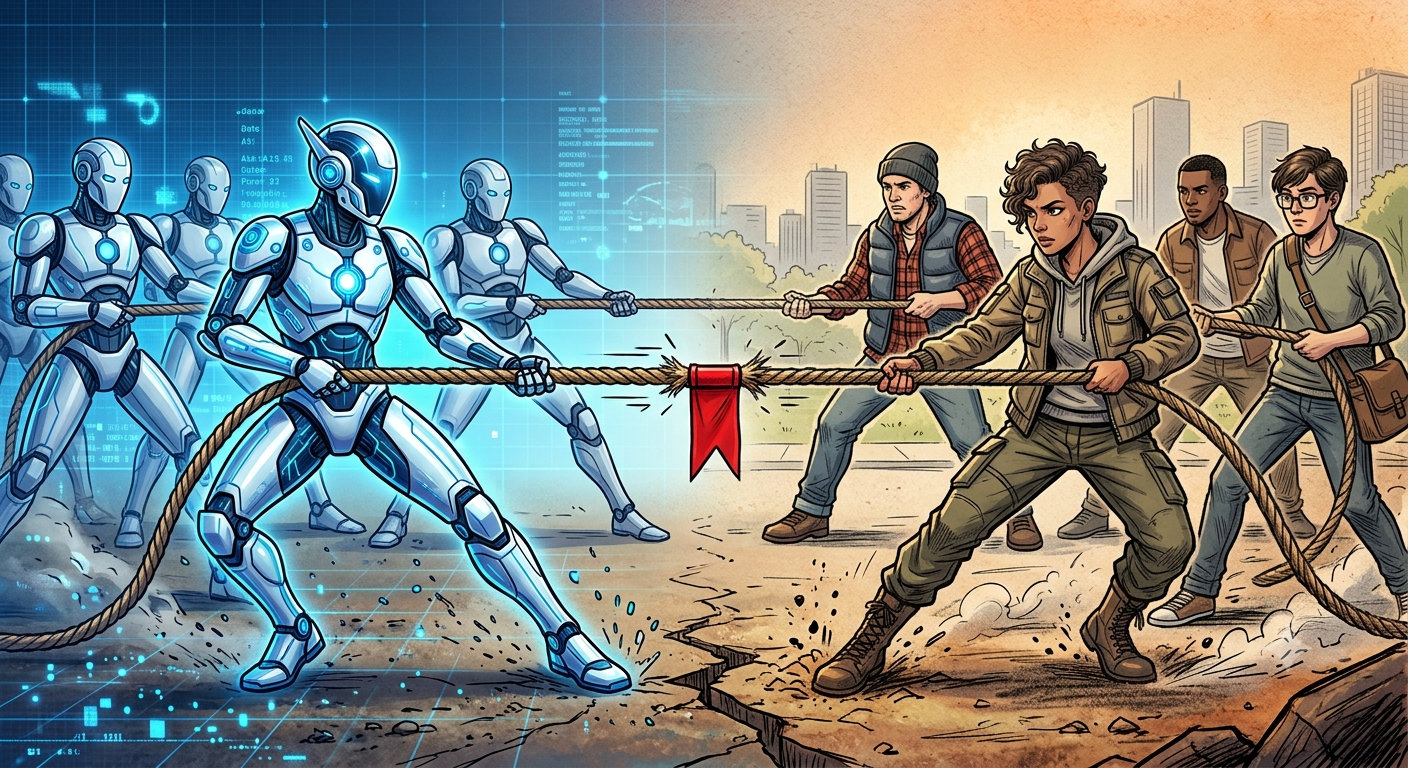
The future is unlikely to be a battle between humans and machines.
Instead, it will be a negotiation between convenience and connection.
The tension between AI automation and human authenticity is not a temporary phase. It is one of the defining cultural challenges of 2026.
Automation offers extraordinary benefits. It removes friction, expands capability, and creates new opportunities for innovation. At the same time, it forces society to reconsider what makes human contributions meaningful.
As AI becomes more capable, authenticity becomes more valuable.
Not because humans can outperform machines at every task, but because people continue to seek something technology cannot fully replicate: genuine experience, intention, and connection.
The future may not belong to those who reject AI or those who automate everything.
It may belong to those who learn how to use powerful tools without losing the human voice behind them.
Frequently asked questions
What is the 'authenticity paradox' in the context of AI automation?+
The authenticity paradox describes the cultural challenge in 2026 where, despite AI automation significantly increasing efficiency and productivity, there's a growing human desire for genuine, human-created content and interactions. As AI becomes ubiquitous, distinctly human qualities gain value.
How does invisible AI automation impact daily life in 2026?+
By 2026, AI is so integrated into digital products that it often operates unseen, shaping outputs and decisions. This fosters an expectation of speed and efficiency in all areas, from professional tasks to personal communications, making AI adoption almost mandatory in many fields.
Why is trust becoming a competitive advantage with AI use?+
As AI generates more sophisticated content, consumers seek transparency. Organizations that openly disclose their AI usage often build more trust than those who conceal it. Trust flourishes when the line between human judgment and technological assistance is clear.
How does AI automation redefine human creativity?+
AI doesn't eliminate creativity but shifts its focus. Creators spend less time on routine tasks and more on refining ideas and making strategic decisions. However, the challenge lies in avoiding creative sameness and bringing unique human perspectives to stand out from AI-generated outputs.
What human qualities remain important despite widespread AI automation?+
Even with advanced AI, leadership, empathy, ethical judgment, relationship-building, mentorship, intuition, and accountability remain uniquely human and increasingly crucial. AI handles technical tasks, but these interpersonal and critical thinking skills become more valuable.