Your Marketing Doesn't Work in Isolation
Discover why successful business growth depends on connecting your website, digital marketing, CRM and sales strategy into one seamless customer journey.
Why Connecting Marketing, Websites and Sales Drives Business Growth
Discover why successful business growth depends on connecting your website, digital marketing, CRM and sales strategy into one seamless customer journey.
Introduction: More marketing doesn't always mean more growth
You’re investing in marketing. Your social media channels are active, your website looks professional, SEO is underway and perhaps you're even running paid advertising campaigns.
But there's one question worth asking:
Is all that activity actually translating into business growth?
For many businesses, the problem isn't necessarily a lack of marketing. It's that the different parts of their digital strategy aren't working together.
Marketing generates interest, but sales teams aren't always following up effectively. Websites attract visitors, but don't convert enough of them into enquiries. Leads come through different channels, but there's no central system to manage them.
The result? Missed opportunities, wasted investment and a customer journey that feels disconnected.
In today's competitive digital landscape, businesses need more than individual marketing activities. They need a connected digital ecosystem where their website, marketing, technology and sales processes work towards the same objective.
Let's explore why that matters.
1. Marketing attracts attention, but what happens next?
Digital marketing is often measured through visibility.
Website traffic, social media engagement, impressions, clicks and follower numbers all provide useful information. However, they don't necessarily tell you whether your business is growing.
Imagine a business running a successful advertising campaign.
Hundreds of potential customers visit its website. Several complete an enquiry form, but the enquiries aren't followed up promptly. Some leads get lost in email inboxes, while others never receive a response.
The advertising campaign might be performing well, but the overall customer journey is failing.
This highlights an important distinction:
Generating leads is only one part of generating revenue.
Your marketing strategy needs to connect with what happens after someone discovers your business.
That means considering:
How visitors move through your website.
Whether your messaging gives them a reason to enquire.
How quickly enquiries are acknowledged.
How leads are tracked and managed.
Whether your sales process encourages potential customers to take the next step.
Marketing creates the opportunity. Your website and sales processes need to make the most of it.
2. Your website should be more than a digital shop window
Your website is often the first meaningful interaction someone has with your business.
Yet many businesses still treat their websites as online brochures rather than essential business tools.
A good website shouldn't simply explain what you do. It should help potential customers understand why they should choose you.
That means getting several things right.
Clear messaging: Visitors should understand what you offer, who you help and what makes your business different.
User experience: Navigation should feel intuitive, information should be easy to find and the experience should work across devices.
Performance: Slow-loading pages and unnecessary complexity can create friction and discourage potential customers.
Conversion opportunities: Calls to action, enquiry forms and relevant information should make it easy for visitors to take the next step.
Search visibility: Your website needs a strong SEO foundation so that the right people can discover your business.
A website that looks impressive but doesn't support your business objectives is missing a significant opportunity.
The best websites combine design, technology, content and strategy to turn interest into action.
3. Understanding your audience makes every marketing decision stronger
One of the biggest mistakes businesses make is trying to appeal to everyone.
When your messaging is too broad, it becomes difficult for potential customers to understand whether your product or service is right for them.
Effective marketing starts with understanding your audience.
Consider:
What problems are your customers trying to solve?
What questions do they ask before making a purchase?
What concerns might prevent them from choosing your business?
Which digital platforms do they use?
What information do they need before they're ready to buy?
These insights should influence everything from your website content and SEO strategy to your social media campaigns and advertising.
For example, someone discovering your business for the first time may need educational content explaining a problem. Someone comparing providers may need case studies, testimonials or a clearer explanation of your services.
The message should reflect where that person is in their decision-making journey.
When you understand your audience, marketing becomes less about shouting louder and more about communicating something relevant.
4. SEO should attract the right people, not just more visitors
Search engine optimisation remains an important part of building sustainable online visibility.
However, ranking for keywords isn't the ultimate objective.
The real opportunity lies in attracting people who are actively looking for the products, services or solutions your business provides.
This is where search intent becomes important.
Someone searching for general information may be at the beginning of their research. Someone searching for a specific service or comparing providers may be much closer to making a decision.
Your content strategy should recognise those differences.
A strong SEO approach combines:
Keyword research based on genuine customer questions.
Helpful content that addresses specific search intent.
Technically sound websites that search engines can understand.
Relevant internal links connecting related information.
Optimised service pages that support enquiries.
Regular content improvements based on performance data.
Publishing more content isn't automatically the answer.
A smaller collection of genuinely useful, well-optimised pages can be more valuable than dozens of articles created simply to fill a content calendar.
The objective is to build authority, establish trust and make it easier for potential customers to find you when they need you.
5. CRM and technology help turn opportunities into relationships
Once marketing starts generating enquiries, businesses need a reliable way to manage them.
This is where customer relationship management (CRM) systems and connected technology can make a significant difference.
Without an organised process, important information can become scattered across spreadsheets, emails, messaging platforms and individual team members.
A properly implemented CRM helps bring that information together.
It can help businesses:
Store customer and prospect information centrally.
Track enquiries and sales opportunities.
Monitor where leads come from.
Automate reminders and follow-ups.
Improve communication between marketing and sales teams.
Understand how opportunities progress through the pipeline.
More importantly, the right technology should fit the way your business operates.
It shouldn't create unnecessary administration or force your team into complicated processes.
When your website, marketing platforms and CRM work together, you gain a clearer picture of the customer journey and can identify where opportunities are being missed.
Technology should make business processes easier, not more complicated.
6. Measure business outcomes, not just marketing activity
Another common challenge is focusing on metrics that look impressive without necessarily reflecting commercial performance.
A campaign might generate thousands of impressions, but how many qualified enquiries did it produce?
A website might experience a significant increase in traffic, but are visitors taking meaningful action?
To understand whether your digital strategy is working, you need to look beyond surface-level engagement.
Consider monitoring:
Qualified leads generated.
Website enquiry and conversion rates.
Cost per lead.
Lead-to-customer conversion rates.
Organic traffic from relevant searches.
Customer acquisition costs.
Sales pipeline performance.
These metrics help connect marketing activity to business objectives.
They also make it easier to identify what needs improving.
Perhaps your advertising is attracting the wrong audience. Maybe your website needs clearer calls to action. Or perhaps your sales process needs a more consistent follow-up system.
Data helps you make those decisions with greater confidence.
The goal isn't to collect more numbers. It's to understand what those numbers are telling you.
7. Building a connected digital strategy
So, what does a connected digital strategy actually look like?
It starts with bringing the different elements of your business together.
Consider the following journey:
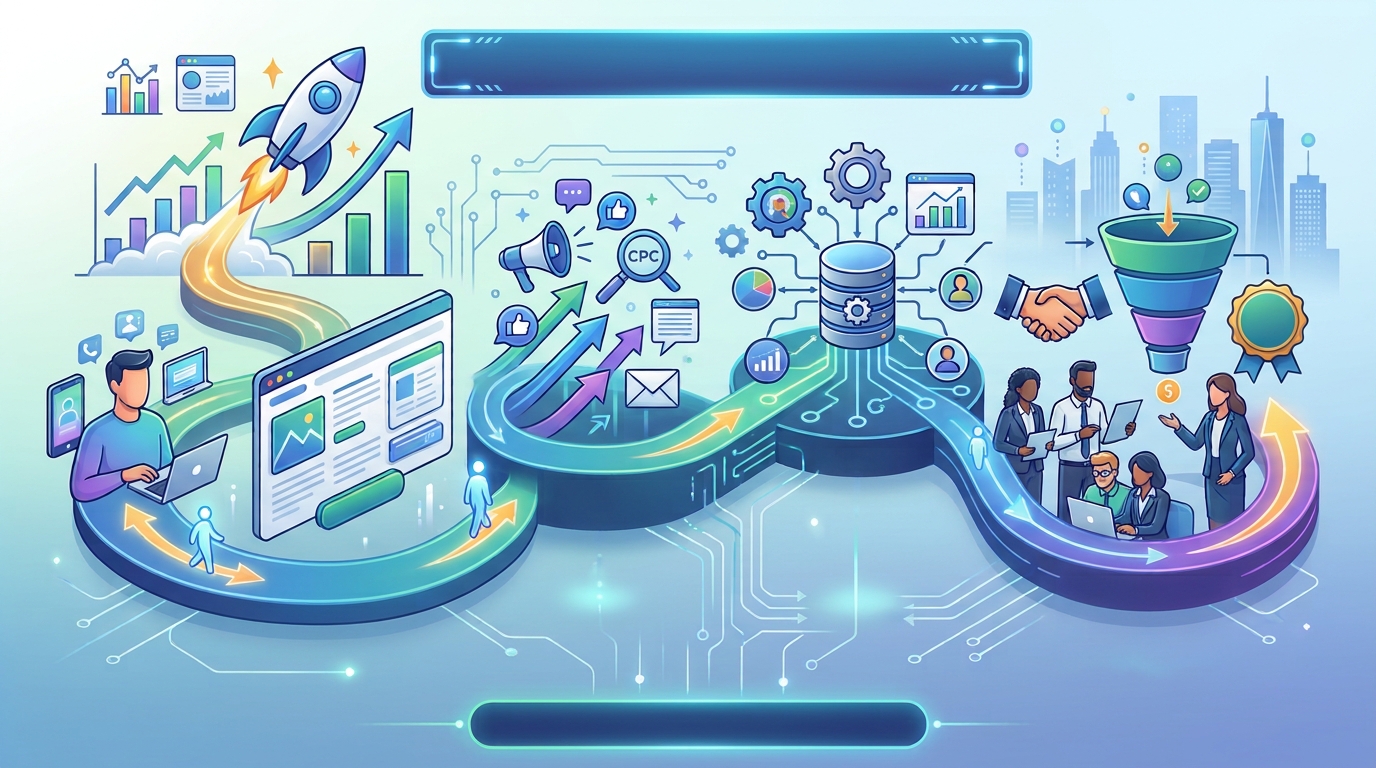
Website → Digital Marketing → Lead Generation → CRM → Sales → Customer Relationship
Each stage has a role to play.
Your website communicates your value and encourages action.
Digital marketing attracts the right audience.
Lead generation captures interest.
Your CRM organises and tracks opportunities.
Your sales process turns qualified opportunities into customers.
Ongoing communication helps build long-term relationships.
When these elements are aligned, businesses can create a more consistent experience for customers while improving visibility across their operations.
This doesn't mean investing in every available platform or adopting the latest technology simply because it's trending.
It means understanding your objectives, identifying gaps and choosing the right solutions to address them.
Sometimes the biggest improvement doesn't come from launching another campaign. It comes from fixing the connection between the systems you already have.
Final thoughts: Stop treating digital as separate activities
Sustainable business growth rarely comes from one isolated marketing campaign, one website redesign or one new piece of technology.
It comes from having the right strategy behind everything you do.
Your website, marketing, SEO, CRM and sales processes should support one another rather than operate independently.
When they work together, you can attract more relevant audiences, create better customer experiences, manage opportunities more effectively and make smarter decisions about future investment.
At FK Digital Alliance, we believe digital success starts with understanding the bigger picture.
It's not simply about getting more clicks, publishing more content or adopting more technology.
It's about making every digital touchpoint work harder for your business.
Ready to connect the dots in your digital strategy?
Whether you need a stronger website, a more focused marketing strategy, better digital systems or an independent perspective on your next move, FK Digital Alliance can help you identify the opportunities and build a practical way forward.
Visit FK Digital Alliance to explore how a more connected digital approach can support your business growth.
Frequently asked questions
Why does digital marketing fail when operating in isolation?+
Digital marketing fails in isolation because driving visibility alone does not guarantee conversions or revenue. When marketing campaigns are disconnected from website conversion pathways, CRM tracking, and timely sales follow-up, prospective leads drop out of the customer journey. Sustainable business growth requires every marketing touchpoint to work seamlessly alongside intuitive design and active sales processes.
What is a connected digital marketing strategy?+
A connected digital marketing strategy aligns search engine optimisation, digital advertising, content, website design, and sales systems into a single customer journey. Instead of treating channels as separate silos, it ensures that traffic is guided toward high-performing landing pages, captured efficiently via automated CRM tools, and followed up promptly by your sales team to maximise revenue.
How do you connect your website to your sales process?+
You can connect your website to your sales process by integrating direct CRM lead capture forms, implementing automated email notifications, and optimising user journeys for high-intent actions. Clear calls to action, friction-free forms, fast page loading, and structured tracking ensure that every inbound enquiry is logged instantly and routed directly to sales teams for immediate response.
How does search intent improve digital marketing conversions?+
Search intent improves digital marketing conversions by ensuring your content matches what a user actually wants to accomplish. By distinguishing between informational queries and high-intent commercial searches, businesses can craft targeted landing pages that address specific pain points, answer purchase-ready questions, and provide direct pathways to conversion rather than just driving generic website traffic.