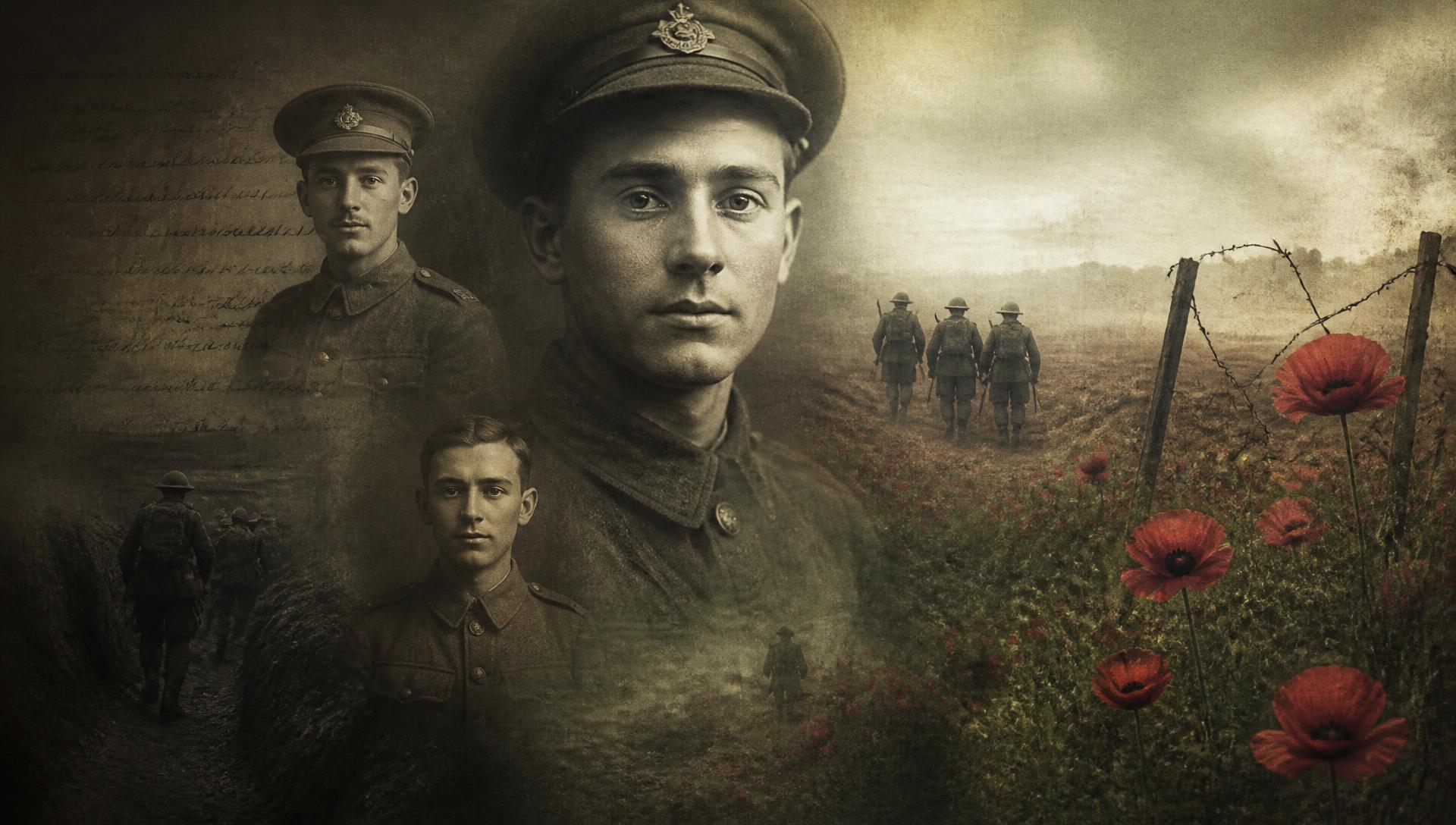

The Great War Register: 75,000 First World War lives, searchable in seconds
A public research archive that turns scattered spreadsheets of soldiers, regiments, memorials and rolls of honour into ranked search, linked records and a navigable map of each soldier’s connections.
The Great War Register is a free-to-search archive of First World War service records, built by FK Digital Alliance. It brings soldiers, battalions, regiments, memorials, rolls of honour and written sources into one place, so families and researchers can trace a name from a single search to everywhere it appears in the record.
Challenge
Decades of research, locked in workbooks
The archive existed as Excel workbooks and legacy .xls files spread across many tabs, plus ZIP folders of memorial and roll-of-honour photographs. The information was rich, but only usable by the person who compiled it.
- Tens of thousands of rows across multiple files and sheets, with inconsistent columns, duplicate men and free-text dates.
- Regiments, battalions, memorials and sources referenced by abbreviations and spelling variants rather than consistent identifiers.
- Over 1,500 photographs named by hand, without reliable links to the records they illustrated.
- No public search by surname, service number or memorial, or a way to explore a soldier’s connections.
- No way for the archivist to add records or images without technical help.
- A public site with accounts and cookies needed privacy information and consent controls for UK visitors.
Objectives
Project Objectives
A clean, unified archive
Import every workbook tab, deduplicate soldiers, normalise dates and link records to regiments, units, memorials, rolls of honour and written sources.
Search that finds the right man first
Weighted ranking prioritises exact service numbers and surnames, with surname and memorial autocomplete.
Faceted, filterable results
Live counts by regiment, unit, rank, fate, memorial and source, with dependent battalion filters and date-of-death ranges.
Records that tell a story
Service details, chronological timelines, structured citations, an image lightbox and a relationship graph.
An archive the owner runs
CSV import, manual entry, bulk image upload, filename matching, manual remapping and an audit trail.
Public access and privacy controls
Accounts for saving records, UK GDPR privacy information, a PECR cookie policy and a consent dialog that remembers visitors’ choices.
Solution
One register, every connection
From workbooks to a connected archive
The source files were parsed sheet by sheet, cleaned and loaded into a relational PostgreSQL model of soldiers, regiments, units, memorials, rolls of honour, written sources and archive images. Three successive data drops, including a Worcestershire collection and a war memorials file, were merged with deduplication, taking the supplied archive snapshot to 75,287 soldiers.
Photographs were connected to records through filename and fuzzy token matching, then served from a CDN. The archive brings together 379 regiments, 693 memorials and 128 rolls of honour, with more than 900 images matched.
Ranked search and live filters
Search uses a database function with trigram indexes and explicit ranking weights: exact service number, exact surname, exact full name, then prefix matches. A single aggregate query computes facet counts together. Indexed prefix lookups provide surname suggestions with record counts and matching memorials.
A research trail, not an isolated record
Each soldier page combines service details, a timeline drawn from dates and archive notes, per-event citations and a radial relationship graph with a plain-English connection summary. Selecting a node opens the linked regiment, unit or memorial. Breadcrumbs and back/forward controls retain the research trail.
Owner-run publishing
Signed-in admins import CSVs, enter records manually, upload photographs and correct image matches, with changes recorded in an audit trail. Visitors can create an account to save records. Privacy and cookie policies are accompanied by a consent dialog offering optional-cookie acceptance or essential-only use.
Results
The Impact
Tech
Technology Stack
FAQ
Frequently asked questions
Good to knowWhere did the data come from?+
From the archivist’s Excel and legacy .xls workbooks, imported across every tab, cleaned, deduplicated and linked into one relational model.
How does the search decide what to show first?+
Weighted ranking prioritises exact service numbers, then exact surnames, full names and prefix matches.
Can the archive keep growing?+
Yes. Admins can upload CSVs with column mapping, add records manually, and upload photographs with filename matching and manual remapping.
How are images connected to records?+
Filenames are matched against memorial, roll and soldier records, with fuzzy token matching for variants. Matches and corrections are logged in an audit trail.
What privacy controls are included for UK visitors?+
The site includes a UK GDPR privacy policy, a PECR cookie policy and a consent dialog offering Accept all or Essential only. These provisions are not presented as an independent legal certification.
Bespoke web application development
The Great War Register is a searchable historical database application with ranked search and linked records. Explore how we design and build custom web applications and bespoke software at our Birmingham studio.
More case studies

Where the Wye Wanders: a commission-free booking marketplace for the Wye Valley
86 live listings, 31 property owners and two-way calendar syncing, built from a standing start in six months.

A browser studio that speaks hologram hardware
Hologram Studio turns PNGs, GIFs, video, 3D models and typed text into device-ready hologram content, rendered client-side and exported in the exact formats a Pepper's Ghost pyramid or a 576-LED fan expects.

Quote, approve, produce: one workflow for branded apparel
A custom quoting system connecting supplier catalogues, garment pricing, customer approvals and production preparation for Corporate Connection.
Ready to Achieve Similar Results?
Let's talk about how we can drive comparable growth for your business.